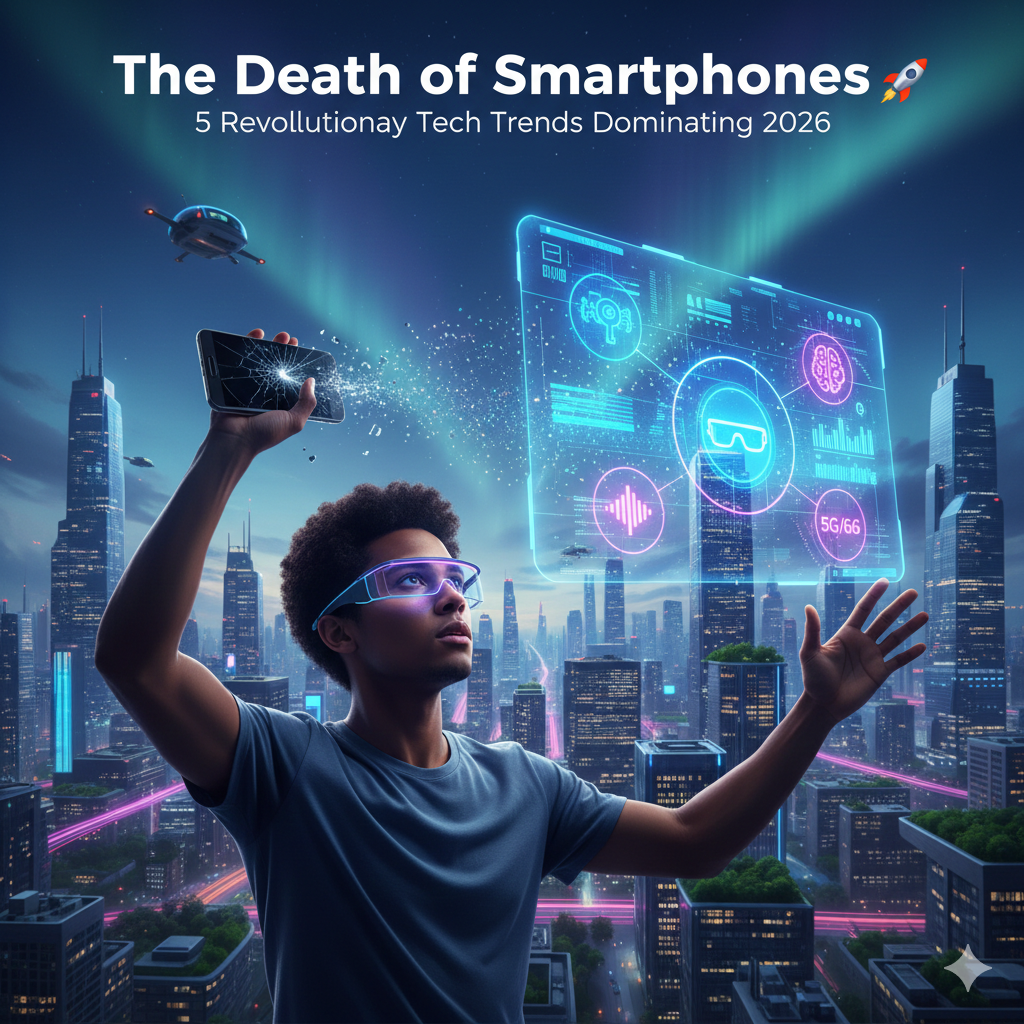
The Death of Smartphones: 5 Revolutionary Tech Trends Dominating 2026 🚀
In aTake a look at your hand right now. You’re likely holding a smartphone. But what if I told you that by late 2026, that device will feel as ancient as a rotary phone? In a world where innovation is the name of the game, the “death of smartphones” is no longer science fiction—it’s a business reality. The rapid evolution of spatial computing and neural interfaces suggests that the handheld rectangles we rely on today are about to become relics of the past.
Here are the 5 groundbreaking trends redefining our digital existence in 2026. 🌍
1. The Rise of Augmented Reality (AR) & Spatial Computing 👓
AR has moved beyond simple filters to become the cornerstone of the post-smartphone era. Sleek, lightweight AR glasses now seamlessly blend digital data with the physical world, rendering pocket-sized screens obsolete. 🕶️
Need to locate a café or navigate a complex subway station? Virtual pointers now appear directly in your field of vision. This shift isn’t just about convenience; it’s about freeing our hands and eyes from the downward “smartphone slouch.”
[CTA 1] 🛒 Explore the Best AR Glasses & Future-Ready Tech on Amazon
2. Ambient Voice-Activated Interfaces 🗣️
As the Internet of Things (IoT) matures, we are moving toward “Ambient Intelligence.” Our interaction with technology is no longer tethered to a screen but to the air around us. In 2026, voice-activated interfaces dominate everything from smart home ecosystems to autonomous vehicles. The hands-free experience is the new gold standard for accessibility and efficiency.
3. Bio-Integrated Wearable Tech ⌚
Wearables have evolved from simple fitness trackers into sophisticated bio-monitors. By 2026, smart clothing and jewelry provide real-time health data and haptic feedback, acting as a secondary nervous system. Imagine a shirt that subtly vibrates to correct your posture or headphones that adjust noise cancellation based on your stress levels. 🦾
[CTA 2] 🔋 Stay Powered Up: Top-Rated Power Banks & Tech Organizers for 2026 (Amazon)
4. Brain-Computer Interfaces (BCI): The Ultimate Shortcut 🧠
Neuroscience has finally bridged the gap between thought and action. BCIs are now allowing users to control digital interfaces purely through neural signals. While initially designed for accessibility, 2026 sees the early adoption of BCIs for high-speed communication—sending a text or making a call just by visualizing the intent.
5. 5G/6G & Smart City Infrastructure 🌐
The backbone of this revolution is hyper-connectivity. With the widespread rollout of 5G (and early 6G trials), the “central hub” (the smartphone) is no longer necessary. The city itself becomes the computer. Automated vehicles, smart grids, and localized edge computing handle the heavy lifting, making seamless interaction a reality everywhere you go.🚦
Tech in Action: The Smart City Experience 🛤️
How do these technologies look when applied in the real world? Some of the world’s leading tech hubs are already integrating these trends into their tourism and urban infrastructure.
- [Tech & Travel] How Osaka’s Smart City Infrastructure is Transforming Tourism in 2026 — Read Full Case Study
- Augmented Heritage: Using AR to Explore Ancient Sites in Japan — Discover the Future of Travel
Conclusion: Embrace the Post-Smartphone Era 🚀
The death of smartphones isn’t a loss; it’s an evolution toward a world where technology partners with us rather than distracting us. By embracing these trends, we move toward a future filled with seamless possibilities.
[CTA 3] ✍️ What’s your take? Are you ready to trade your smartphone for AR glasses and neural links? Let’s discuss the future in the comments below! 👇